Exterior remodeling rarely starts with clean, controlled conditions.
Contractors are constantly bonding new materials to aged siding, weathered coatings, mixed substrates, or unknown legacy sealants. These variables introduce risk—especially at transitions where movement, moisture, and exposure are highest.
When compatibility is overlooked, the result is often:
That’s why sealant compatibility—not just strength—has become one of the most critical considerations in exterior remodeling.
Modern hybrid polymer sealants are changing how professionals approach these challenges by delivering reliable, primerless adhesion across common exterior substrates.
Quick Answer: What Sealants Work Best for Exterior Remodeling Without Primers?Modern hybrid polymer sealants bond to most common exterior remodeling materials—including painted wood, PVC trim, aluminum, fiber cement, vinyl, and masonry—without the need for primers. This makes them especially well-suited for remodel scenarios where substrate conditions are unknown or inconsistent. |
Why Sealant Compatibility Matters in Exterior Remodeling Projects
Exterior remodels introduce more variables than new construction. Materials expand and contract at different rates, existing coatings may be degraded, and moisture exposure is constant.
When sealants aren’t compatible with the substrates they’re applied to, failure typically shows up as:
In these conditions, compatibility matters more than raw tensile strength.
A sealant that bonds reliably and stays elastic across multiple substrates is far more valuable than one that simply tests strong under ideal conditions.
Exterior remodeling includes updates and repairs to a building’s exterior envelope—such as siding replacement, trim installation, window and door upgrades, flashing repairs, and sealing exterior joints.
These projects often involve bonding new materials to existing, weathered surfaces, making material compatibility and long-term adhesion critical to performance.
Exterior remodeling rarely involves a single, clean substrate. More often, contractors are sealing joints and transitions across aged, mixed, or weathered materials—each with different movement and adhesion characteristics.
The table below breaks down common exterior remodeling scenarios, the substrates typically involved, where failures occur, and what to look for in a sealant.
|
Exterior remodeling application |
Common exterior remodeling materials |
Common sealant challenges in exterior remodeling |
Best sealant characteristics for exterior remodeling |
|
New trim installed over existing siding |
Painted wood, fiber cement, vinyl siding, aluminum cladding |
Chalky or UV-degraded paint, uneven or textured surfaces |
Primerless adhesion, flexibility for movement, paintability |
|
Window & door replacements |
Wood framing, PVC trim, aluminum flashing, masonry, or fiber cement |
Multiple materials in a single opening, exposure to water and UV |
Multi-substrate adhesion, long-term elasticity, weather & UV resistance |
|
Mixed-material transitions |
PVC trim to masonry, metal flashing to siding, fiber cement to wood |
Differential expansion, incompatible chemistries, joint movement |
Elastic hybrid polymer formulation that maintains adhesion |
In these scenarios, compatibility and elasticity matter more than raw strength. Sealants must stay bonded as materials expand, contract, and weather over time—without relying on primers or perfect surface conditions.
One of the biggest advantages of modern hybrid polymer sealants is their ability to bond across common exterior substrates without primers, even in remodeling conditions where surfaces aren’t new or uniform.
Substrates that typically bond well with hybrid polymer sealants:
Substrates that may require extra consideration:
While hybrid polymer sealants eliminate primers in most applications, basic surface evaluation still matters. Loose material, contamination, or structural degradation should be addressed to ensure long-term performance.
Exterior remodeling demands efficiency without sacrificing performance. Hybrid polymer sealants are engineered specifically for these conditions, helping contractors work faster while reducing risk.
Key advantages include:
By eliminating primers and reducing surface prep steps, hybrid polymer sealants streamline installation and help standardize results across a wide range of remodel jobs.
Hybrid polymer sealants significantly reduce prep time—but they don’t eliminate the need for proper surface evaluation.
What you can usually skip:
What still matters:
The goal isn’t perfect surfaces—it’s sound surfaces. Hybrid polymer sealants are designed to perform on aged materials; however, adhesion still depends on the basic substrate integrity.
Exterior remodeling projects place unique demands on sealants due to exposure, movement, and mixed-material transitions.
Not all exterior sealants are designed for remodeling conditions. When selecting a sealant, contractors should evaluate factors that directly affect long-term performance—not just product strength claims.
Key considerations include:
Compatibility with known and unknown substrates
Expected joint movement and expansion
UV exposure and weather resistance
Paintability and finished appearance
Application conditions (vertical joints, overhead work, temperature range)
Sealants developed for controlled, new-build environments often fall short in remodel applications. Products formulated for flexibility and compatibility perform more reliably over time.
Primers add cost, time, and complexity—especially when working across multiple materials on the same project.
Many construction professionals are moving away from primer-dependent systems because they offer:
Hybrid polymer sealants reduce dependence on primers while delivering consistent adhesion where traditional systems struggle.
Seal Bond’s hybrid polymer sealants are engineered specifically for exterior remodeling applications where traditional primer-dependent systems fall short.
With reliable primerless adhesion, long-term elasticity, and proven exterior durability, our products help construction professionals reduce rework, minimize callbacks, and install with confidence across roofing, siding, windows, gutters, and solar applications.
Not sure which product is right for your next job?
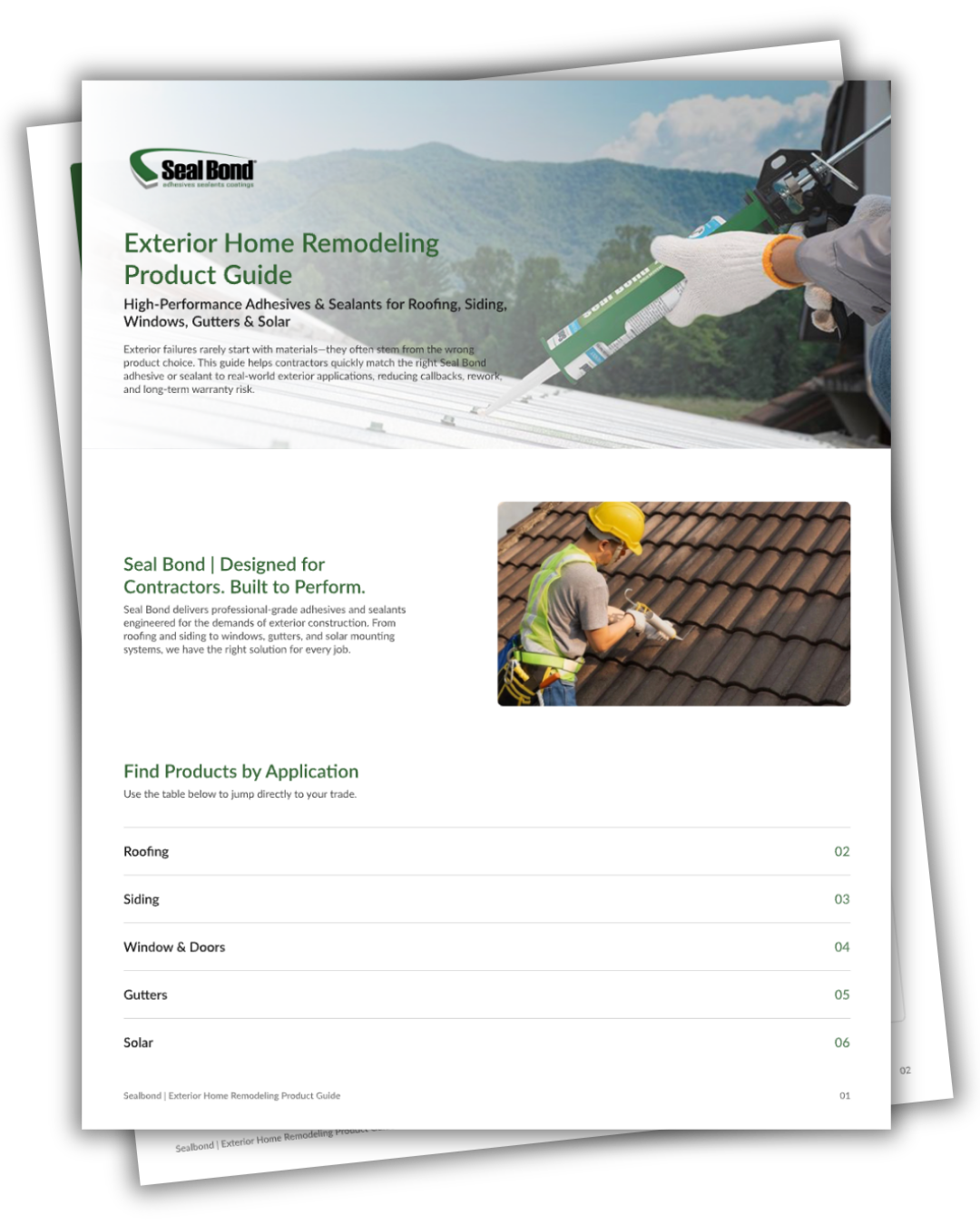
Our Exterior Home Remodeling Product Guide breaks down recommended solutions by application, making it easy to choose the right sealant the first time.
Download the Exterior Product Guide, browse our selection of sealants and adhesives, or request a free sample today.