Quick Answer: What Is a 2-Part MS Adhesive?A 2-part MS adhesive (also called a dual-component MS adhesive or 2K SMP adhesive) is a hybrid adhesive system that cures through a chemical reaction rather than moisture.
Best for: high-speed production, structural bonding, and multi-substrate industrial assembly. |
Most adhesives don’t just create tradeoffs. They create problems on your production floor.
Faster cure times can mean less control.
Stronger bonds can mean less flexibility.
And inconsistent curing can slow throughput, increase rework, and create bottlenecks across your operation.
For industrial manufacturers, those tradeoffs don’t stay theoretical—they show up as missed timelines, wasted material, and production inefficiencies.
That’s where dual-component MS adhesives come in.
Also known as 2K SMP adhesives, these systems deliver fast-curing MS adhesive performance without sacrificing the durability of a high-strength, flexible adhesive.
In this blog, we’ll break down how two-component MS polymer adhesives work, why they’re gaining traction in industrial applications, and how Seal Bond® 212K helps teams improve speed, consistency, and long-term performance.
Who Is This For?
This matters for teams responsible for keeping production moving and performance consistent:
- Manufacturing engineers optimizing throughput and cycle times
- Operations leaders reducing rework, downtime, and production variability
- Product Development Teams bonding dissimilar materials like metal, glass, and composites
Manufacturers replacing moisture-cure or slow-setting adhesives that limit efficiency
What Is a 2-Part MS Adhesive?
A 2-part MS adhesive (two-component MS polymer adhesive) is a hybrid system that cures through a chemical reaction between two components, rather than moisture.
This allows for:
- Faster, more controlled curing
- Consistent performance across environments
- Strong, flexible bonds across multiple substrates
Unlike traditional one-component adhesives, 2-part systems are designed for high-throughput manufacturing and structural bonding applications.
This makes 2-part MS adhesives ideal for manufacturing environments where speed and consistency matter.
How Do 2-Part MS Adhesives Work?
Two-component MS adhesives combine:
- Component A (base polymer)
- Component B (curing agent)
When mixed (typically at a 1:1 ratio), a chemical reaction begins that drives the curing process.
This reaction is controlled by the mix ratio and begins immediately at the point of dispensing, allowing precise control over working time and cure speed.
Why this matters:
- Cures independent of moisture → more predictable results
- Faster strength development → reduced wait times
- Less environmental variability → more consistent output
This makes them ideal for controlled production environments where timing and repeatability matter.
2-Part vs 1-Part Adhesives: Which Performs Better in Production?
The key difference comes down to how the adhesive cures:
- 1-part adhesives rely on moisture in the air to cure
- 2-part adhesives cure through a controlled chemical reaction
In short: 2-part adhesives offer faster, more predictable performance—especially in controlled production environments.
Why Are Manufacturers Moving Away from 1-Part Adhesives?
Traditional one-component systems still have their place, but they come with limitations:
Common challenges:
- Slower cure times (especially in low humidity)
- Inconsistent results across environments
- Limited control over working time and strength development
What 2-part systems improve:
The shift isn’t just about chemistry; it’s about production control.
Manufacturers are moving away from 1-part systems because they introduce hard-to-scale variability.
|
Limitation (1-Part) |
Improvement (2-Part MS Adhesive) |
|
Moisture-dependent curing |
Independent chemical cure |
|
Slower strength development |
Rapid strength build |
|
Variable performance |
Consistent, repeatable results |
|
Limited process control |
Controlled working time |
How 2-Part MS Adhesives Improve Production Workflows
For manufacturers, adhesives aren’t just materials—they directly impact cycle time, labor efficiency, and output.
2-part MS adhesives help:
- Reduce cure-related delays in production
- Improve consistency across shifts and operators
- Minimize rework caused by inconsistent bonding
- Support faster assembly timelines
What Are the Key Benefits of Seal Bond® 212K?
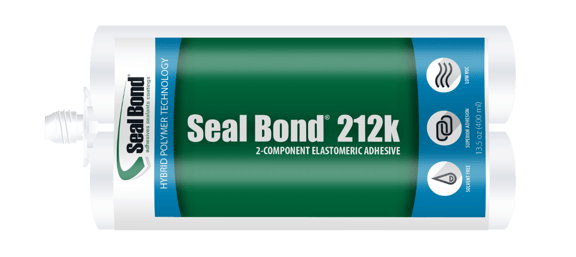
Seal Bond® 212K is engineered to solve these production challenges directly.
1. Fast, Controlled Cure for Production Efficiency
Because SB 212K cures independently of moisture, it delivers predictable cure times and rapid strength development. This helps reduce bottlenecks and improve throughput.
2. High Strength with Exceptional Flexibility
With high elongation (~464%) and strong mechanical properties, SB 212K provides:
- Durable structural bonding
- Resistance to vibration and movement
- Long-term joint integrity
3. Broad Substrate Compatibility
SB 212K adheres to a wide range of materials, including:
- Aluminum
- Cold-rolled steel
- Fiberglass
- Glass
- Stainless steel
- Wood
This makes it ideal for bonding dissimilar materials in manufacturing.
4. Non-Sag, Easy Application
The non-sag formulation allows vertical and overhead applications without movement or slumping, improving application consistency and reducing rework.
5. Strong Environmental Resistance
Designed for real-world conditions, SB 212K offers:
- Resistance to temperature extremes (-65°F to 250°F)
- Excellent environmental durability
- Long-term performance in demanding environments
In real-world terms, this means faster builds, fewer delays, and more consistent results.
What Applications Is SB 212K Best For?
SB 212K is well-suited for a wide range of industrial applications, including:
Transportation
- Trailer panel bonding (sidewalls, roofs, and floors)
- Vehicle body assembly (bus, truck, and specialty vehicles)
- Bonding aluminum, steel, and composite components
Manufacturing
- Metal-to-composite bonding for equipment and enclosures
- Electrical and industrial enclosure assembly
- Appliance and equipment panel bonding
HVAC Systems
- Sealing and bonding ductwork under vibration
- HVAC unit assembly and component bonding
- Airflow system sealing where flexibility is required
General Industrial
- Maintenance and repair applications (MRO)
- Equipment assembly across mixed substrates
- Sealing joints exposed to movement, moisture, or temperature changes
These align with common use cases like metal bonding, glass bonding, and trailer manufacturing.
Request a sample to test SB 212K in your application →
SB 212K vs. Traditional Adhesives
|
Feature |
SB 212K (2-Part MS) |
Traditional Adhesives |
|
Cure Mechanism |
Chemical (2-part) |
Moisture-dependent |
|
Cure Speed |
Fast, controlled |
Variable |
|
Flexibility |
High |
Moderate |
|
Substrate Range |
Broad |
Limited |
|
Production Consistency |
High |
Variable |
While both systems can be used for structural bonding, 2-part MS adhesives like SB 212K are better suited for production environments where speed, consistency, and control are critical.
When Should You Use a 2-Part MS Adhesive?
A 2-component MS adhesive like SB 212K is the right choice when:
- You need faster production cycles
- Your process requires consistent curing
- You’re bonding multiple or dissimilar substrates
- Your application involves movement, vibration, or stress
- You want to reduce rework and variability
Scale Production Without the Usual Adhesive Tradeoffs
For manufacturers, adhesive selection directly impacts production performance.
Choosing the right system can improve:
- Throughput
- Consistency
- Product performance
- Long-term durability
Seal Bond® 212K is built to eliminate the traditional tradeoffs between speed, strength, and flexibility—helping teams scale production with confidence.
If you're evaluating fast-curing adhesives or looking for a two-component alternative, it’s worth a closer look.
👉 Request a sample and test it in your application
👉 Talk with our team about replacing your current adhesive
Frequently Asked Questions
What is a 2-part MS adhesive used for?
2-part MS adhesives are used for structural bonding, manufacturing assembly, and applications requiring fast curing and flexible, high-strength bonds.
What is the advantage of a two-component MS polymer adhesive?
Two-component MS polymer adhesives offer faster, controlled curing, improved consistency, and better performance across varying environmental conditions.
Does a 2-part MS adhesive cure faster than a 1-part adhesive?
Yes, a 2-part MS adhesive cures faster than a 1-part adhesive because it cures via a chemical reaction rather than relying on moisture, resulting in faster, more predictable strength development.