
Quick Answer: What Is the Best Concrete Sealer for Access Floor Systems?The best concrete sealer for access floor systems is a penetrating densifier. It strengthens and dustproofs the concrete while allowing pedestal adhesives to bond directly to the substrate. Topical (film-forming) sealers can reduce adhesive performance by creating a barrier between the adhesive and the concrete. |
Key Takeaways:
- Penetrating densifiers are best for access floor systems
- They allow direct adhesive-to-concrete bonding
- Topical sealers can introduce bond failure risk
- Use topical sealers only when chemical resistance or aesthetics are required
Why Do Concrete Sealers Matter in Access Floor Systems?
Concrete sealers play a critical role in the performance of raised access flooring systems, especially in environments like data centers, cleanrooms, and commercial buildings where underfloor air plenums are common.
This guide breaks down the difference between penetrating and topical concrete sealers—and how to choose the best option for raised access flooring systems.
A properly selected sealer helps:
- Reduce concrete dusting in air plenums
- Protect against moisture intrusion
- Improve long-term substrate durability
- Support reliable pedestal adhesive performance
Without proper treatment, issues such as adhesive failure, dust contamination, and moisture-related damage can compromise the entire system.
What’s the Difference Between Penetrating and Topical Concrete Sealers?
Concrete sealers for access floor systems generally fall into two categories: penetrating densifiers and topical (film-forming) sealers.
Comparison: Penetrating vs. Topical Sealers for Access Floors
|
Feature |
Penetrating Sealer (Densifier) |
Topical Sealer (Film-Forming) |
|
Adhesive Bond |
✅ Bonds directly to concrete |
⚠️ Bond depends on coating adhesion |
|
Moisture Protection |
Internal (within slab) |
Surface-level barrier |
|
Chemical Resistance |
Limited |
Strong |
|
Dust Proofing |
Excellent |
Moderate |
|
Cost |
Lower |
Higher |
|
Best Use |
Access floor systems |
Decorative/industrial coatings |
When Should You Use a Penetrating vs. Topical Concrete Sealer?
Choosing between a penetrating and topical concrete sealer depends on how the space will be used and what performance matters most in your access floor system.
Use a penetrating densifier when:
- Installing raised access floors with pedestal adhesives
- Working in data centers or cleanroom environments
- Dust control and adhesive bond strength are critical
Use a topical sealer when:
- Chemical resistance is a top priority
- The surface will remain exposed
- Aesthetic finish (color or gloss) is required
What Is a Penetrating Concrete Sealer (Densifier)?
Penetrating sealers (often silicate-, siliconate-, silane-, or siloxane-based) work by reacting within concrete pores to strengthen and densify the substrate.
Benefits of Penetrating Concrete Sealers for Access Floor Systems:
- Maintains adhesive bond strength: pedestal adhesives bond directly to the concrete surface
- Improves internal durability: strengthens the slab from within
- Reduces dusting: ideal for air plenums and controlled environments
- Lower cost option compared to topical coatings
Limitations:
- Limited resistance to surface chemicals
- Does not significantly change surface appearance
- Does not fully eliminate vapor transmission
Recommended Solution:
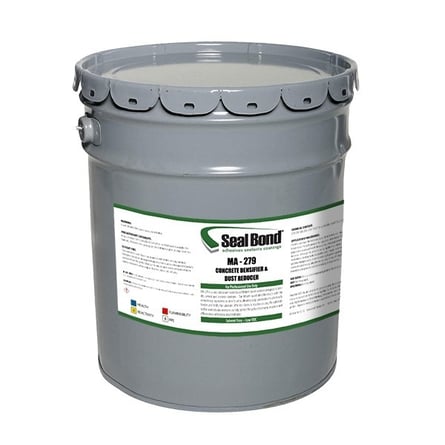
Seal Bond® MA 279 Concrete Densifier is a penetrating concrete sealer designed for access floor systems. It strengthens and dustproofs concrete while maintaining full compatibility with pedestal adhesives.
What Is a Topical (Film-Forming) Concrete Sealer?
Topical sealers, such as acrylics, epoxies, and polyurethanes, form a protective coating on the surface of the concrete.
Benefits of Topical Concrete Sealers for Access Floor Systems:
- Strong chemical resistance
- Enhanced moisture barrier at the surface
- Improved appearance (color, gloss, finish options)
Limitations:
- Can interfere with adhesive bonding to the concrete
- Higher material and application costs
- Does not improve the internal strength of the slab
Where They Fit:
Topical sealers may be appropriate in environments where chemical exposure or surface aesthetics are the priority, but they require careful consideration when used with pedestal adhesives.
How Do Concrete Sealers Affect Pedestal Adhesive Performance?
Concrete sealers directly affect how well pedestal adhesives bond—and ultimately determine the stability and load performance of the entire access floor system.
With Penetrating Sealers:
- Adhesive bonds directly to the concrete substrate
- Typically results in strong, reliable pedestal adhesion
With Topical Sealers:
- Adhesive bonds to the coating—not the concrete
- Overall system strength depends on:
- Bond between adhesive and coating
- Bond between coating and concrete
This introduces additional risk if the coating fails.
Impact of Sealer Choice on Access Floor Performance
|
Scenario |
Penetrating Sealer |
Topical Sealer |
|
Adhesive Bond Strength |
High (direct bond to concrete) |
Variable (depends on coating adhesion) |
|
Risk of System Failure |
Low |
Higher if coating fails |
|
Long-Term Stability |
Strong and consistent |
Dependent on surface layer integrity |
|
Installation Reliability |
Predictable |
Requires additional validation |
|
Best Fit |
Structural access floor systems |
Surface protection applications |
Compatibility Considerations for Adhesives and Sealers
Chemical compatibility refers to how well materials perform when used together.
While pedestal adhesives like Seal Bond® SB 95 may be chemically compatible with many sealers when properly cured, Seal Bond does not guarantee bond strength between:
- The sealer and the concrete
- The adhesive and the sealer layer
Best practice:
Always follow manufacturer guidelines for mixing, curing, and application before installing pedestals.
What Happens If You Use the Wrong Concrete Sealer?
Using the wrong concrete sealer in an access floor system can lead to failures that don’t show up until after installation—when they’re the most expensive and disruptive to fix.
Common issues include:
- Pedestal adhesive failure
- Reduced load-bearing stability
- Increased system movement
- Moisture-related damage
- Costly rework and project delays
For contractors and specifiers, these failures don’t just affect performance—they also impact timelines, budgets, and long-term reliability.
Best Practice: Always Perform Field Testing
Even when products are compatible on paper, real-world performance should always be verified through field testing.
To ensure system performance meets project specifications, Seal Bond recommends conducting a field test such as the CISCA-approved Overturning Moment Test.
This test evaluates the full system, including:
- Concrete substrate
- Sealer
- Pedestal
- Adhesive
Field testing helps confirm that all components work together to meet engineering and performance requirements before full installation.
How to Choose the Right Concrete Sealer for Your Application
Selecting the right concrete sealer requires balancing adhesive performance, environmental exposure, and long-term system durability.
When evaluating options, consider:
- Adhesive compatibility requirements
- Moisture conditions within the slab
- Exposure to chemicals or contaminants
- Performance expectations for the system
For most access floor applications, penetrating densifiers offer the best balance of performance, cost, and reliability.
Frequently Asked Questions About Concrete Sealers for Access Floors:
Do concrete sealers affect pedestal adhesive strength?
Yes. Penetrating sealers allow adhesives to bond directly to the concrete, while topical sealers can reduce bond strength by introducing a coating layer between the adhesive and substrate.
Can you use epoxy under raised access floors?
You can use epoxy coatings, but they may impact adhesive performance. The overall bond strength will depend on how well the epoxy adheres to the concrete and how well the adhesive bonds to the epoxy surface.
Do penetrating sealers stop moisture vapor?
No. Penetrating sealers improve internal moisture resistance but typically do not completely eliminate vapor transmission.
What is the difference between a densifier and a concrete sealer?
A densifier is a penetrating sealer that strengthens concrete internally, while other sealers (such as topical coatings) form a protective surface layer.
What is the best sealer for concrete under raised floors?
A penetrating densifier is typically the best choice because it allows adhesives to bond directly to the concrete while improving durability and dust control.
Do you need to seal concrete before installing access flooring?
Yes. Sealing concrete helps reduce dust, improve durability, and support consistent adhesive performance—especially in air plenum environments.
Get the Right Solution for Your Access Floor System
Choosing the right concrete sealer is critical to ensuring long-term performance, stability, and reliability in access floor systems.
Seal Bond helps contractors, engineers, and specifiers select the right combination of concrete densifiers, sealers, and pedestal adhesives for real-world applications.
👉 Get a concrete sealer recommendation for your access floor system or request a free sample.
Tell us about your application, and our team will help you choose the right solution for long-term performance.