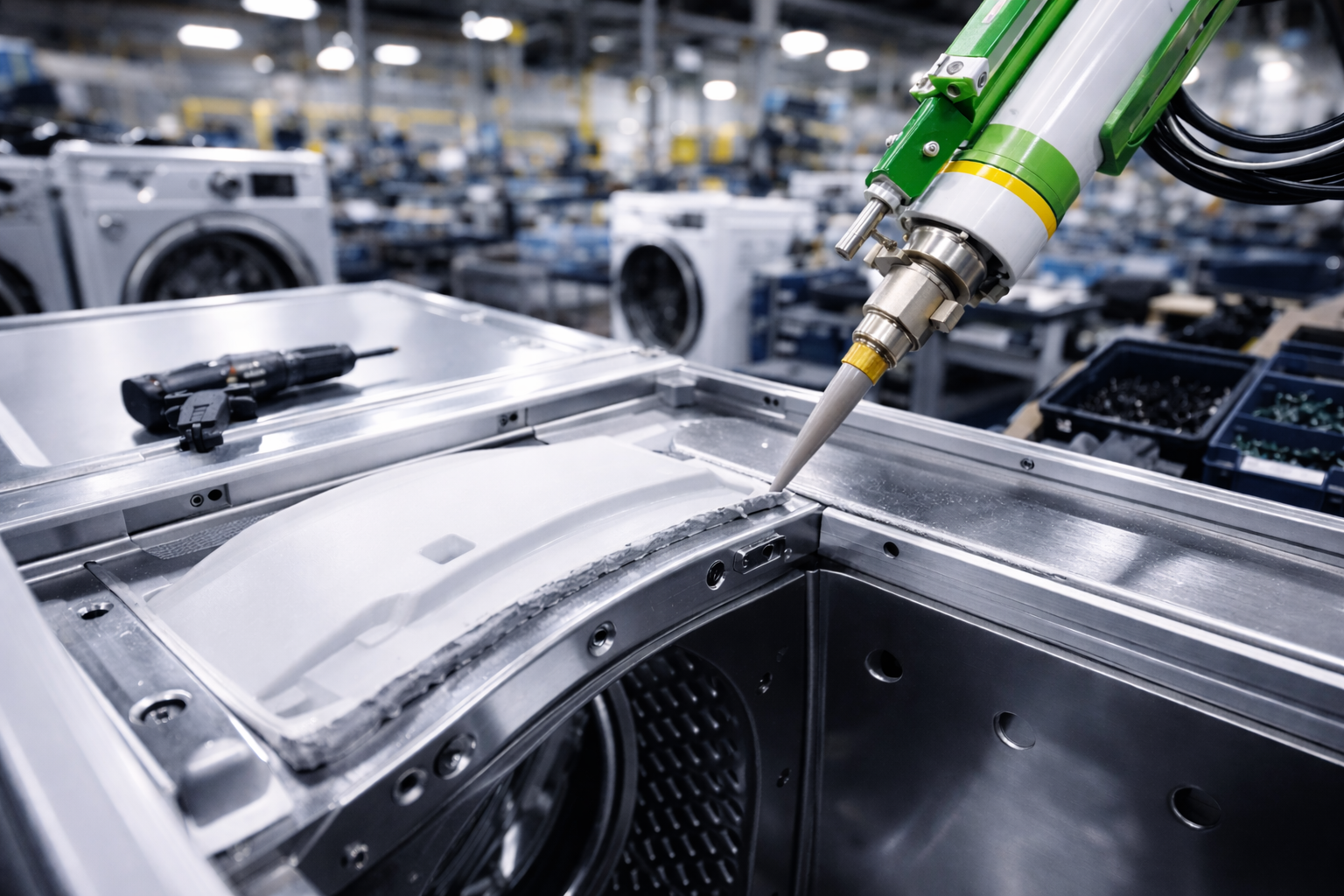
Production line optimization remains a top priority for industrial manufacturers. Especially as they’re facing tighter labor markets, rising material costs, and increasing pressure to produce more—faster and more consistently.
While many optimization efforts focus on automation, staffing, or equipment upgrades, one area is still frequently overlooked: adhesives and sealants.
Bonding and sealing steps directly impact line speed, tack time, and overall equipment effectiveness (OEE). Advances in curing adhesive technology (particularly hybrid polymer formulations) are changing how manufacturers think about these processes, unlocking new opportunities to reduce downtime without sacrificing long-term performance.
Why Do Adhesives Matter in Production Line Optimization?
In many assembly environments, bonding and sealing operations quietly become bottlenecks.
Traditional adhesive cure profiles often require extended fixture or clamp times, forcing downstream stations to wait and creating unnecessary work-in-progress inventory.
Common challenges with slower-curing materials include:
- Long hold or fixture times that reduce line speed
- Delayed handoffs between assembly stations
- Congestion caused by parts waiting to reach handling strength
Cure speed has a direct, measurable impact on throughput. When parts reach green strength faster, they can be moved down the line sooner—improving flow, stabilizing tack time, and increasing overall line efficiency.
What “Fast Strength Build” Really Means in Industrial Manufacturing
In industrial manufacturing, “fast” does not mean instant full cure.
For production line optimization, speed is defined by how quickly an adhesive develops usable green strength—the point at which parts can be safely fixtured, unclamped, moved, or processed downstream without compromising bond integrity.
While most hybrid polymer adhesives still require extended time to reach full cure and ultimate performance properties, those long-term cure timelines are rarely what limit throughput on the production floor. Instead, bottlenecks are created when assemblies must wait to achieve sufficient early strength before advancing to the next station.
When evaluating adhesives for production environments, manufacturers should focus on:
- Green strength development: How quickly bonded parts reach handling or fixture strength
- Fixture time: How long components must remain clamped or staged
- Environmental sensitivity: Performance consistency across temperature and humidity conditions
- Full cure timeline: When long-term mechanical and durability properties are achieved
Fast strength-build adhesives are engineered to shorten fixture time and accelerate material flow—without sacrificing long-term bond performance once fully cured.
How Does Hybrid Polymer Chemistry Enable Faster Curing Without Tradeoffs?
Advancements in adhesive chemistry are driving real efficiency gains on the production floor.
Hybrid polymer formulations are specifically designed to balance competing demands that traditional chemistries often struggle with.
These formulations deliver:
- Rapid skin-over and cure times
- Elasticity to accommodate movement, vibration, and thermal expansion
- Long-term adhesion across mixed substrates
Primer-less adhesion is another advantage in production environments, simplifying surface preparation and reducing process variability. Fewer prep steps mean fewer opportunities for error—and faster, more repeatable assembly.
From a lean manufacturing perspective, hybrid polymer adhesives support:
- Shorter fixture and clamp times
- Faster transitions between stations
- Reduced rework caused by incomplete or inconsistent curing
The result is better line balancing, more efficient staffing, and improved consistency in tack time.
3 Ways To Improve Throughput Across Key Industrial Applications
1. Appliance Assembly
Fast-curing adhesives enable manufacturers to bond cabinets, panels, and internal components without slowing down final assembly. Quicker handling strength supports high-volume production while improving consistency across units.
2. Transportation Equipment
For components exposed to dynamic loads and environmental stress, faster curing supports higher line speeds without compromising durability. Assemblies can move downstream sooner while still meeting performance and longevity requirements.
3. Trailer Manufacturing
In trailer assembly, bonding solutions must strike a balance between speed and vibration resistance. Hybrid polymers enable rapid structural and trim assembly while minimizing staging and wait times between build phases.
How To Select the Right Adhesive for Production Line Optimization
Not all products perform the same in real-world manufacturing conditions.
Selecting the right solution starts with asking the right questions:
- Q. What open time is required versus cure time?
- Q. Which substrates are being bonded or sealed?
- Q. What temperature, humidity, or environmental variables exist on the line?
Application-specific testing is critical. Line trials ensure the adhesive performs as expected within your actual process—not just under ideal lab conditions.
Seal Bond Solutions Designed for Fast Strength Build on the Line
Seal Bond develops hybrid polymer adhesive and sealant technologies engineered to support fast strength build and quick fixturing in demanding production environments. These solutions are designed to help manufacturers reduce hold times, minimize work-in-progress inventory, and stabilize tack time—without compromising durability after full cure.
Seal Bond® 105 – Fast Strength Build / Fast Fixture
Seal Bond® 105 is a high-performance adhesive/sealant developed for industrial applications that require early handling strength, elasticity, and reliable primerless adhesion across a wide range of substrates. 
Key performance benefits include:
- Fast strength development to reduce fixture and clamp time
- Primerless adhesion to many unprimed industrial substrates
- Permanently elastic bond for movement and vibration resistance
- Solvent- and isocyanate-free formulation
SB 105 is well-suited for production lines where minimizing hold time is critical while maintaining long-term flexibility and durability.
Seal Bond® 150 HV – Fast Green Strength for Demanding Applications
Seal Bond® 150 HV is designed for applications requiring very high green strength and rapid fixturing—particularly when bonding difficult substrates or operating in challenging environmental conditions.
Key performance benefits include:
- High green strength for quick fixturing and early handling
- Extremely strong bonds with long-term flexibility
- Broad substrate compatibility, including metals, plastics, FRP, glass, wood, and concrete
- Ability to cure at temperatures as low as 13°F
- Extremely low shrinkage and paint-compatible finish
SB 150 HV is ideal for production environments where early strength development is crucial for maintaining line speed and throughput, even in cold or variable conditions.
Stop Letting Cure Time Limit Line Performance
Adhesives designed for fast strength build are more than a materials decision—they’re a practical lever for production line optimization.
When bonding and sealing steps are engineered for rapid green strength development and consistent fixturing, manufacturers can reduce bottlenecks, improve throughput, and stabilize tack time across the entire operation—without sacrificing long-term bond performance after full cure.
If you’re evaluating ways to reduce bottlenecks, improve throughput, or stabilize tack time, connect with Seal Bond to discuss solutions tailored to your production challenges—or request a sample for line testing.