
Sealant failure can happen when the movement in a joint exceeds what the sealant can stretch, compress, and recover from — showing up as cracking, shrinking, or a bead pulling away from the substrate.
On a siding job, that shows up as a callback: another truck roll, more material, and hours of labor spent fixing work your crew already finished.
During your busiest stretch of the year, that lost time can be especially expensive. Every hour spent on a callback is an hour you aren't spending on the next paying job.
Most siding sealant failures come down to a mismatch between how much the joint moves and how much movement the sealant was designed to handle. Fiber cement siding responds to both temperature and moisture, which puts more stress on the joint than many contractors expect. If the sealant can't accommodate that movement, cracking, shrinkage, or adhesion loss follows — and so does the phone call.
Here's what causes siding sealant failure, where sealant doesn't belong at all, and what to check before the tube goes in the gun.
Key Takeaways:
- Sealant failure occurs when joint movement exceeds what the sealant is designed to accommodate.
- Fiber cement siding responds to both temperature and moisture, so movement capability and adhesion both matter.
- James Hardie's published installation instructions call for an elastomeric joint sealant complying with ASTM C920, Grade NS, Class 25 or higher.
- Seal Bond® 435 Multi-Purpose Sealant is ASTM C920 Type S, Grade NS, Class 35, Uses NT, T, G, A & O — with 259% elongation at break and 268 psi tensile strength.
- Not every joint should be sealed. Manufacturer instructions specify locations to leave open, and caulking them anyway can trap moisture.
- SB 435 is available in 350+ colors, with published color-match guides for James Hardie, LP SmartSide ExpertFinish, Diamond Kote, CertainTeed, Pella, Milgard, ProVia and more.
What Does a Sealant Failure Actually Cost a Contractor?
Quick Answer: A sealant callback costs far more than the replacement material. Between drive time, removal, re-prep, reapplication, crew labor, and the paying job you had to reschedule, a single callback typically consumes half a day of crew capacity — against a few dollars of sealant.
A callback means sending your crew back to a job you already closed out. It requires:
- Drive time to and from the jobsite
- Removing the failed sealant
- Cleaning and re-prepping the joint
- Applying new material
- Additional crew labor
- Rescheduling other paying work
And then there's the cost that's harder to measure: the homeowner's confidence in your work.
If a customer sees cracked, separated, or mismatched sealant a few months after installation, they aren't necessarily thinking about joint movement or material performance. They see a problem with the finished job—and they call you.
The highest cost during the busy season may be calendar space. A morning spent repairing yesterday's job can push today's installation behind, creating a ripple effect across your schedule.
What Does Sealant Failure Look Like on Siding?
Quick Answer: Sealant failure on siding shows up in six ways: cracking or splitting, adhesion loss at one or both joint faces, excessive shrinkage, hardening, open joints, and visible color mismatch. The last one causes callbacks even when the sealant is performing correctly.
Failure isn't limited to a bead that has cracked apart. Watch for:
- Cracking or splitting: The sealant tears as the joint expands or contracts.
- Adhesion loss: The bead pulls away from one or both sides of the joint.
- Excessive shrinkage: The bead becomes smaller and exposes gaps.
- Hardening: The sealant loses the flexibility needed to accommodate movement.
- Open joints: Movement creates gaps that can compromise the finished installation.
- Visible color mismatch: The sealant may still perform, but an obvious mismatch can still result in a homeowner complaint or callback.
When these problems appear repeatedly, it's worth looking beyond application technique and considering whether the sealant itself is suited to the substrate and expected joint movement.
Why Do Sealants Crack or Shrink on Fiber Cement Board?
Quick Answer: Fiber cement is made from cellulose fibers, sand, and Portland cement, and it responds to both temperature change and moisture change. That produces more joint movement than temperature alone, and a sealant with insufficient movement capability eventually cracks, tears, or loses adhesion.
Unlike materials that primarily respond to temperature, fiber cement board also moves with moisture. The sealant between siding boards, trim, windows, doors, and other transitions has to stay flexible as both conditions change — through hot summers, cold winters, and wet seasons.
That means the sealant between siding boards, trim, windows, doors, and other transitions needs to remain flexible as conditions change.
If the sealant can't stretch and recover with the joint, repeated movement can eventually result in cracking, tearing, or adhesion loss.
That's why choosing a fiber cement board sealant isn't simply a matter of grabbing whatever exterior caulk happens to be on the truck. Contractors should consider both adhesion to the substrate and the amount of movement the sealant is designed to accommodate.
What Is Joint Movement and Why Does It Matter?
Quick Answer: Joint movement is the repeated expansion and contraction of building materials as temperature and moisture change. A sealant has to absorb that cycling for years without cracking, tearing, or losing adhesion — which is a different requirement than stretching once.
Think of a rubber band. Stretching it once is easy. Stretching and recovering thousands of times over a decade is the actual test.
That's the job of an elastomeric sealant.
An elastomeric sealant is formulated to stretch and recover rather than becoming rigid as the joint moves. One way contractors can evaluate that capability is through the product's ASTM C920 classification.
What Does ASTM C920 Class 35 Mean?
ASTM C920 is the ASTM International standard specification for elastomeric joint sealants. It classifies products by type (single or multi-component), grade (non-sag or self-leveling), class (movement capability), and use (the substrates and conditions it's qualified for).
Reading a full classification tells you a lot quickly. Seal Bond® 435 Multi-Purpose Sealant is:
- Type S — single component, no mixing on site
- Grade NS — non-sag, so it stays where you tool it on a vertical joint
- Class 35 — tested to ±35% movement
- Uses NT, T, G, A & O — qualified for non-traffic and traffic surfaces, glass, aluminum, and other substrates
That's a documented specification you can check, rather than a word like "premium" or "flexible" on a label.
How Do You Choose a Sealant That Supports Siding Warranty Requirements?
Quick Answer: Start with the siding manufacturer's published installation instructions. James Hardie's Hardie® Trim instructions, for example, call for "an Elastomeric Joint Sealant complying with ASTM C920 Grade NS, Class 25 or higher." Checking the product's C920 classification against that minimum rules most products in or out immediately.
There's no such thing as a universally approved sealant — requirements come from the siding manufacturer, and they differ by product line and revision. But the requirement is usually stated plainly, and it's usually about the C920 classification.
Before using a sealant on a siding installation, verify four things:
- Movement class — does the published ASTM C920 class meet or exceed what the siding manufacturer specifies? Class 25 is a common floor; Class 35 gives you additional margin.
- Grade — most vertical siding joints call for Grade NS (non-sag).
- Substrate compatibility — is the product qualified for fiber cement, vinyl, aluminum, and the adjacent materials on your job?
- Surface preparation — does the application require priming, backer rod, or a specific joint depth-to-width ratio?
Seal Bond® 435 is Grade NS, Class 35 — above the Class 25 minimum published in the Hardie Trim instructions, with margin for joints that move more than expected.
Always check the current installation instructions for the specific siding product you're installing, along with the sealant manufacturer's technical data sheet. Manufacturers revise these documents.
Why Use an Elastomeric Sealant Like Seal Bond® 435 for Siding?
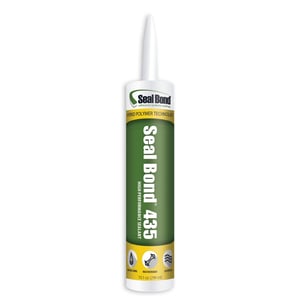
Seal Bond® 435 Multi-Purpose Sealant (SB 435) is a single-component, non-sag, moisture-cure hybrid polymer built for exterior joints that move.
At ASTM C920 Type S, Grade NS, Class 35 with 259% elongation at break, it's rated to stretch and recover with the joint rather than becoming the weak point between two moving materials. It's solvent-free, isocyanate-free, non-silicone, 100% solids, paint compatible, low odor, and non-flammable — and its C920 Uses listing covers glass, aluminum, and other common substrates, which matters on a job where a crew crosses four materials before lunch.
Key Siding Sealant Specifications to Compare |
||
|---|---|---|
|
Specification: |
What to look for: |
Seal Bond® 435: |
|
ASTM C920 class |
Meet or exceed the siding manufacturer's minimum (commonly Class 25) |
Class 35 (±35% movement) |
|
Type |
Type S for single-component, no site mixing |
Type S |
|
Grade |
Grade NS for vertical joints |
Grade NS (non-sag) |
|
C920 Uses |
Qualified for the substrates on your job |
NT, T, G, A & O |
|
Elongation at break |
Documented stretch before failure |
259% |
|
Tensile strength |
Published psi value |
268 psi |
|
Hardness |
Flexible enough to keep moving with the joint |
50 Shore A |
|
Service temperature |
Full range of local conditions |
–40 °F to 199 °F (–40 °C to 93 °C) |
|
Tack-free time |
Fast enough to resist dust and rain pickup |
30 minutes (21 °C, 50% RH) |
|
Chemistry |
Solvent-free, isocyanate-free, non-silicone, paintable |
Hybrid polymer, moisture cure |
|
Color availability |
Match to the specific siding, window, and trim brand |
350+ colors, published brand-match guides |
Choosing on price per tube alone hides the real cost. These are the specifications that predict whether the joint is still sound in five years.
Why Sealant Color Matters More Than Contractors Expect
Quick Answer: A visibly mismatched bead generates callbacks even when the sealant is performing perfectly. Matching the sealant to the specific siding, window, or trim brand — rather than settling for a generic "almond" or "tan" — removes an entire category of callback that has nothing to do with performance.
Not every callback starts with a cracked bead. Sometimes the sealant is doing exactly what it was designed to do, and the homeowner can simply see that it doesn't match.
A noticeably mismatched bead around a window, door, trim board, or siding transition can turn into another trip to the jobsite even when there isn't a performance problem.
Seal Bond® 435 is available in more than 350 colors, with published color-match guides — a downloadable reference per manufacturer — for brands including:
- Fiber cement and engineered wood: James Hardie, LP SmartSide ExpertFinish, Diamond Kote
- Vinyl siding: Mastic by PlyGem, CertainTeed Siding, Wolverine by CertainTeed, Exterior Portfolio by Royal, Royal Residential Vinyl Siding, CraneBoard, Quality Edge, GenTek
- Windows and doors: Pella Windows & Doors, Milgard Windows & Doors, Simonton Windows, ProVia Windows & Doors, International Window
That's a color matched to the product you're actually installing, not a close guess from a shelf.
How to Prevent Sealant Callbacks on Your Next Siding Job
Quick Answer: Preventing a sealant callback comes down to five checks before the tube goes in the gun: confirm the ASTM C920 movement class against the manufacturer's minimum, confirm substrate compatibility, confirm surface prep and joint design requirements, confirm which joints should be left unsealed, and match the color to the siding brand.
Run through these before you buy, not after the crew is on the wall:
- Movement class — does the published C920 class meet or exceed what the siding manufacturer requires?
- Substrate compatibility — is the product qualified for fiber cement, vinyl, aluminum, or whatever else is on the job?
- Joint design and prep — right depth-to-width ratio, right backer rod, right surface condition, right application temperature?
- Placement — which joints does the manufacturer say to leave open?
- Color match — will the finished bead disappear, or announce itself?
A cheaper tube isn't much of a savings if your crew has to come back and install it twice.
Choosing a sealant based on documented movement capability, adhesion, and application requirements can help keep finished siding jobs finished—and your schedule focused on paying work.
Keep Your Crew Moving With the Right Siding Sealant
When your schedule is packed, the last thing you need is yesterday's job showing back up on today's schedule.
SB 435 combines Class 35 movement capability, 259% elongation at break, primerless adhesion to most common substrates, and 350+ available colors to give siding installers a high-performance option for demanding exterior joints.
Want to try it on your next siding job? Request a free SB 435 sample.
Frequently Asked Questions About Sealant Failure
What causes sealant to crack on siding?
Sealant can crack when joint movement exceeds the material's ability to stretch and recover. Poor adhesion, improper joint preparation, substrate incompatibility, and application conditions can also contribute to sealant failure.
Can you use sealant on fiber cement siding?
Yes, but the sealant should be compatible with fiber cement and capable of accommodating the expected joint movement. Contractors should also follow the siding manufacturer's current installation requirements and the sealant manufacturer's recommendations.
What sealant works best on fiber cement board?
Look for an elastomeric sealant with documented adhesion to cementitious substrates and an ASTM C920 movement class appropriate for the joint. SB 435 is an ASTM C920 Class 35 sealant with primerless adhesion to most common substrates and 259% elongation at break.
What is ASTM C920 Class 35?
ASTM C920 Class 35 is a movement classification for elastomeric joint sealants. A Class 35 sealant is tested to accommodate ±35% movement in extension and compression under the conditions established by the standard.
What is an elastomeric sealant?
An elastomeric sealant is designed to stretch and recover as a joint expands and contracts. This flexibility helps the sealant maintain the joint as building materials move in response to changing conditions.
What colors does Seal Bond® 435 come in?
SB 435 is available in 350+ colors, including color matches for major siding, window, and door manufacturers. This gives contractors more options for matching sealant to the surrounding exterior materials.
Where can I buy Seal Bond 435?
Seal Bond products are sold through a distributor network of 130+ locations across the United States. Use the Seal Bond Distributor Locator to search by zip code and find suppliers near your jobsite, or request a free sample to evaluate the product first.
How can siding contractors prevent sealant callbacks?
Start by selecting a sealant based on the joint's expected movement, substrate compatibility, adhesion requirements, environmental exposure, and color needs. Proper surface preparation and application according to manufacturer instructions are equally important for long-term performance.