
In rugged industrial environments, the right sealant choice can determine a project's success or failure. Whether you’re sealing heavy equipment bases, transit trailer floors, or facility thresholds, an underperforming material can quickly lead to premature failure, fluid intrusion, and costly operational downtime.
A self-leveling sealant is a low-viscosity sealant designed to flow into joints and seams after application, creating a smooth, uniform seal without manual tooling. In industrial environments, semi-self-leveling sealants are often preferred because they provide controlled flow, preventing runoff while still delivering a consistent finish.
Interested in learning more? You’re in the right place.
What Is a Semi-Self-Leveling Sealant?
A self-leveling sealant is a flowable sealant that automatically spreads and levels itself after application. It is commonly used on horizontal surfaces, concrete joints, floor seams, and industrial assemblies where a smooth, watertight seal is required. Unlike non-sag sealants, self-leveling products do not require manual tooling to create a uniform finish.
What Is a Semi-Self-Leveling Sealant?
A semi-self-leveling sealant provides controlled flow characteristics. It moves enough to fill joints and surface irregularities but resists excessive spreading, making it suitable for slightly sloped surfaces, overlap seams, transportation assemblies, and manufacturing applications.
What Is a Non-Sag Sealant?
A non-sag sealant is formulated to stay exactly where it is applied with little to no flow. It is commonly used for vertical joints, overhead applications, wall seams, and assemblies where movement after application would be undesirable.
Because non-sag sealants do not self-level, they often require tooling to achieve a smooth, uniform appearance. Their ability to maintain shape makes them ideal for applications that require precise placement and maximum control.
Self-Leveling vs. Semi-Self-Leveling vs. Non-Sag Sealants |
|||
|---|---|---|---|
|
Feature |
Self-Leveling |
Semi-Self-Leveling |
Non-Sag |
|
Flow Characteristics |
High flow |
Controlled flow |
Minimal to no flow |
|
Best Surface Orientation |
Horizontal |
Horizontal and slight slopes |
Vertical, horizontal, and overhead |
|
Requires Tooling |
Typically no |
Usually no |
Often yes |
|
Ability to Fill Surface Imperfections |
Excellent |
Very good |
Limited |
|
Risk of Running on Sloped Surfaces |
High |
Low |
None |
|
Appearance After Application |
Smooth, leveled finish |
Smooth, controlled finish |
Tooled finish |
|
Common Applications |
Concrete joints, floor seams, horizontal assemblies |
Transportation assemblies, overlap seams, and manufacturing joints |
Vertical joints, wall seams, façade work, and overhead sealing |
|
Primary Advantage |
Fast, self-leveling coverage |
Balance of flow and control |
Maximum placement control |
In general, self-leveling sealants are best for flat horizontal surfaces, non-sag sealants are best for vertical applications, and semi-self-leveling sealants provide a middle-ground solution when some flow is beneficial but complete leveling is not desirable.
When Should You Use a Self-Leveling Sealant?
A self-leveling sealant is best used when:
- The joint is horizontal or nearly horizontal
- A smooth, uniform finish is required
- Manual tooling would slow production
- Water intrusion protection is critical
- The assembly experiences vibration or movement
Industrial manufacturers commonly use self-leveling and semi-self-leveling sealants for concrete floor joints, equipment bases, transportation assemblies, and overlap seams.
Top Industrial Applications for Controlled-Flow Sealants
From warehouse floors to fleet assembly lines, semi-self-leveling sealants are built for the demanding environments where standard products fall short. Here are the most common applications where controlled-flow performance makes the difference.
1. General Sealing & Concrete Floor Joints
Controlled-flow profiles are ideal for horizontal seams and joints where near-floor-level protection is critical.
Industrial facilities frequently use a semi-self-leveling concrete sealant to protect expansion joints, floor transitions, equipment foundations, and high-traffic work areas. These applications require a sealant that can move with concrete while maintaining a watertight bond.
- Machine bases and equipment mounts
- High-traffic warehouse floor expansion joints
- Facility thresholds and transition seams
The result is a flat, durable surface that seals out water, fine dust, and debris while withstanding heavy forklift traffic and continuous structural vibration.
2. Overlap Seam Sealing
Achieving consistency across overlapping metal panels, fabrication joints, or industrial enclosures can be challenging with traditional pastes. Semi-self-leveling formulas flow slightly upon application, bridging gaps evenly for a uniform, watertight seal that won't shrink or crack over time. Common use cases include:
- Panel assembly and sheet metal fabrication
- Industrial enclosures and equipment housings
- HVAC housing units and ductwork joints
3. Heavy Transportation & Fleet Assembly
Fleet trailers, commercial chassis, and shipping containers face constant over-the-road twisting, structural flexing, and harsh seasonal weather. Semi-self-leveling formulas applied along floor frames and body seams absorb heavy vibration across mixed substrates, directly preventing:
- Water intrusion and structural rust
- Seam failure across aluminum, steel, and composite panels
- Costly mid-season maintenance and downtime
4. RV & Commercial Vehicle Maintenance
Speed and a clean aesthetic finish matter when sealing commercial vehicles or recreational transit lines. These products deliver uniform seam coverage across:
- Exterior roofs and body panels
- Vents, windows, and trim overlaps
- High-flex joints subject to road vibration
No tedious manual tooling required — drastically reducing production rework and turnaround time.
Performance Spotlight: Seal Bond® 190
For manufacturers seeking a semi-self-leveling sealant that combines controlled flow, strong adhesion, and long-term durability, Seal Bond® 190 is engineered to simplify installation and deliver reliable performance in industrial environments.
SB 190 Technical Performance Matrix |
|
|---|---|
|
Specification / Attribute |
Performance Capability |
|
Chemistry Profile |
Advanced, one-component moisture-cure hybrid polymer |
|
Viscosity Behavior |
Precision semi-self-leveling (controlled flow) |
|
Cure Mechanism |
Moisture-cure; ready to handle in approximately 24 hours, full cure in 3–7 days (temperature/humidity dependent) |
|
Substrate Adhesion |
Excellent unprimed bond to aluminum, steel, concrete, wood, PVC, fiberglass, and coated metals |
|
Environmental Safety |
100% solvent-free, isocyanate-free, and ultra-low VOC content |
|
Durability Shield |
Superior UV-stability, permanent water resistance, and zero-shrink performance |
|
System Options |
Available in Gray, Black, and White; packaged in cartridges, pouches, or bulk pails for automated lines |
Why Seal Bond® 190 Stands Out:
When it comes to semi-self-leveling performance, Seal Bond® 190 is engineered to simplify application and improve long-term results.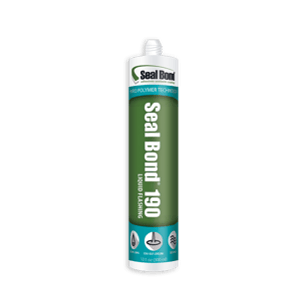
- Engineered for efficiency: Easy to dispense, spread, and tool for faster production and cleaner results.
- Uniform finish: Semi-self-leveling formulation eliminates uneven seams and minimizes rework.
- Lasting durability: Reduces maintenance, labor costs, and downtime by maintaining integrity over time.
- Trusted reliability: Backed by Seal Bond’s commitment to responsive support, custom solutions, and decades of proven performance across industrial markets.
Key Features of SB 190:
- One-component, moisture-cure hybrid polymer technology — applies easily and cures quickly with ambient moisture.
- Unprimed adhesion to a wide range of substrates, including aluminum, steel, wood, PVC, fiberglass, coated
metal, and more. - Solvent- and isocyanate-free with ultra-low VOCs for safer application and compliance with strict environmental standards.
- Water-resistant and UV-stable, maintaining performance in both indoor and outdoor conditions.
- Permanent elastomeric bond that absorbs movement and vibration without cracking or shrinking.
SB 190 is available in black, gray, and white and can be supplied in cartridges or pouches for convenient use with manual or automated dispensing systems.
Frequently Asked Questions:
What is a self-leveling sealant?
A self-leveling sealant is a low-viscosity formula that flows and flattens on its own after application, forming a smooth, uniform seal without manual tooling. Its main advantage over a standard non-sag option is labor savings: the material naturally settles into a flat, consistent layer on horizontal and slightly sloped seams, eliminating the need to manually smooth or "tool" the surface with a spatula.
What is the difference between a self-leveling sealant and a semi-self-leveling sealant?
A self-leveling sealant flows freely across horizontal surfaces and completely levels itself. A semi-self-leveling sealant provides controlled flow, allowing it to fill joints and seams while resisting excessive spreading on slightly sloped surfaces.
What is a self-leveling sealant's main advantage over a standard non-sag option?
A traditional non-sag sealant stays exactly where it is placed and requires manual smoothing or "tooling" with a spatula to create a flat seal. To answer what the self-leveling sealant value is, it comes down to labor savings: the fluid naturally settles into a smooth, perfectly uniform layer, eliminating manual tooling entirely for horizontal and slightly sloped seams.
Where is self-leveling sealant commonly used?
Self-leveling sealants are commonly used in concrete floor joints, industrial facilities, transportation equipment, trailer assemblies, RV manufacturing, HVAC systems, and metal fabrication applications.
Can self-leveling sealant be used on concrete?
Yes. Self-leveling and semi-self-leveling sealants are commonly used on concrete expansion joints, warehouse floors, equipment foundations, and industrial thresholds because they accommodate movement while maintaining a watertight seal.
Can this product be used as a semi-self-leveling concrete sealant for expansion joints?
Yes. Because hybrid polymer formulas like SB 190 retain permanent elastomeric properties, they perform exceptionally well in concrete floor expansions, thresholds, and machinery mounts — flexing easily with building shifts and heavy vehicle traffic without tearing away from the joint walls.
How does a semi-self-leveling sealant prevent manufacturing rework?
A semi-self-leveling sealant helps reduce manufacturing rework by automatically filling minor surface irregularities and creating a consistent seal line without extensive tooling. This improves appearance, reduces labor time, minimizes application errors, and helps prevent future seal failures that require repair or replacement.
How long does self-leveling sealant last?
Service life depends on the formulation and environmental conditions. High-performance hybrid polymer sealants can provide years of reliable performance when properly applied and maintained.
Need Help Selecting the Right Self-Leveling Sealant?
Choosing between a self-leveling sealant, semi-self-leveling sealant, or non-sag sealant depends on your substrates, joint design, environmental exposure, and production requirements.
Seal Bond's technical team can help identify the best solution for your application.
If you’re looking to audit substrate compatibility, optimize your line's automated dispensing equipment, or replace an underperforming product, bypass generic quote requests and connect directly with our technical team.