Cure time, skin time, and tack-free time are three different measurements of how a sealant hardens.
Skin time is how long it takes a thin outer layer to form.
Tack-free time is how long it takes the surface to stop feeling sticky.
Full cure occurs when the sealant reaches its final strength throughout.
Ambient temperature and humidity affect all three, and getting the timing wrong can mean a joint that looks fine but fails months later.
For moisture-cure sealants, warmer temperatures and higher humidity generally accelerate curing, while colder or drier conditions slow it down.
Seal Bond's sealants use moisture-curing technology. They react with humidity in the air to trigger the chemical cross-linking that turns a soft bead into a durable, flexible joint. Because that reaction depends on atmospheric conditions, the temperature and humidity on the jobsite the day you apply the product matter as much as the product itself.
Key Takeaways:
- Cure time, skin time, and tack-free time describe three different stages of a moisture-cure sealant hardening.
- Higher ambient temperature speeds up cure and skin time. Colder jobsite conditions slow both down, sometimes significantly.
- For moisture-cure sealants specifically, higher humidity speeds up curing, because atmospheric moisture is the ingredient that triggers the reaction (the opposite of how humidity affects some other adhesive chemistries).
- Seal Bond® 435 Multi-Purpose Sealant skins over in about 30 minutes at 70°F and 50% relative humidity.
- Full cure happens from the outside in, so thicker beads and joints take longer to cure all the way through than the skin time alone suggests.
What's the Difference Between Cure Time, Skin Time, and Tack-Free Time?
Quick Answer: Skin time (sometimes called skinning time) is how long it takes a thin outer layer to form over the bead. Tack-free time is when the surface stops feeling sticky to the touch. Full cure is when the chemical reaction is complete all the way through the joint and the sealant reaches its final strength. They happen in that order, and none of them are interchangeable.
Cure Time vs. Skin Time vs. Tack-Free Time |
||
|---|---|---|
|
Term: |
What it means: |
Why it matters on the job: |
|
Skin time (skinning time) |
The point when a thin, semi-solid outer layer forms over the bead |
Marks the point past which the surface starts resisting light contact — but the material underneath is still soft |
|
Tack-free time |
The point when the surface no longer feels sticky and stops picking up dust or fingerprints |
Tells you when the joint can be exposed without collecting debris — not when it's fully cured |
|
Full cure |
The point when the chemical cross-linking reaction is complete through the entire bead |
Determines when the sealant reaches its rated strength, movement capability, and chemical resistance |
How Long Does Sealant Take to Fully Cure?
Quick Answer: Moisture-cure sealants can take several days to a few weeks to fully cure, depending on bead thickness, ambient temperature, and humidity.
That gap surprises a lot of contractors. Because moisture-cure sealants react with humidity from the outside in, the surface skins over and goes tack-free well before the center of a thick bead finishes curing.
The main factors that affect sealant cure time are temperature, humidity, sealant chemistry, and bead thickness.
A thin joint on a warm, humid day might reach full cure in days; a deep gap on a cold, dry day can take considerably longer.
That's why technical data sheets list skin time and tack-free time as separate, faster milestones, and why testing a joint's real strength before the cure window has passed gives misleading results.
What Is Skin Time, and Why Does It Matter?
Quick Answer: Skin time, also called skinning time, is the amount of time it takes for a thin outer layer to form over a sealant bead after application. It's typically measured under standardized lab conditions of 70°F and 50% relative humidity so different products can be compared on equal footing.
Skin time matters because it's the first line of defense against dust, rain, and debris landing in an uncured joint, and it marks roughly when a bead can no longer be re-tooled without disturbing the surface. Rain or dust hitting a bead before it skins over can compromise the finished joint — exactly the kind of failure that turns into a callback.
How Is Tack-Free Time Different From Skin Time?
Quick Answer: Tack-free time is when the surface stops feeling sticky to the touch. Skin time is when a thin outer layer first forms. They're close together but not identical, and confusing the two is a common mistake that leads contractors to expose a joint too early.
Because both happen early and close together, it's easy to treat them as the same milestone. They aren't — and the difference matters most in cold or dry conditions, where the gap between the two can widen.
For a deeper breakdown of tack-free time specifically, including how it varies across Seal Bond's product line, see What Does Tack-Free Mean? Tack-Free Time Explained.
What Factors Affect Sealant Cure Time?
Quick Answer: Sealant cure time is primarily affected by ambient temperature, humidity, sealant chemistry, and bead thickness.
For moisture-cure sealants, temperature and atmospheric moisture can significantly change how quickly the sealant cures. Thicker beads generally take longer to cure completely than thin beads.
How Does Ambient Temperature Affect Cure Time and Skin Time?
Quick Answer: Warmer temperatures speed up cure and skin time, and colder temperatures slow both down. A common rule of thumb across adhesive and sealant chemistries is that reaction rate roughly doubles for every 18°F (10°C) increase in ambient temperature, and roughly halves for every 18°F (10°C) decrease.
On the jobsite, that rule of thumb plays out in two directions:
- Cold conditions slow everything down. Below roughly 65°F, cure and skin time start stretching out, and near-freezing temperatures can extend the working and cure window considerably. Cold sealant is also stiffer and harder to gun and tool cleanly.
- Hot conditions speed everything up — sometimes too much. On a hot summer afternoon, a bead can skin over faster than a crew can finish tooling it, which leaves visible tool marks or an uneven surface.
Because the effect compounds quickly, always check the current technical data sheet for the specific product and temperature range you're working in rather than assuming the room-temperature number applies.
Does Humidity Speed Up or Slow Down Cure Time?
Quick Answer: For moisture-cure sealants, higher humidity speeds up cure time, because atmospheric moisture is the ingredient that drives the reaction. That's the opposite of how humidity affects some other adhesive chemistries, where excess moisture can interfere with the cure.
One-component, moisture-cure products cure faster as humidity increases, while two-component systems are far less sensitive to it. In a dry climate or a low-humidity cold front, a moisture-cure sealant like Seal Bond® 435 will skin over and cure more slowly than the datasheet's reference number even at an otherwise ideal temperature. It’s best to plan for a longer protection window in those conditions.
How Fast Does Seal Bond® 435 Skin Over?
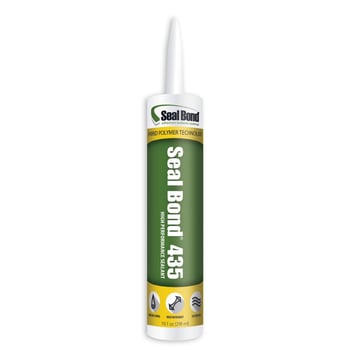
Seal Bond® 435 Multi-Purpose Sealant is a single-component, non-sag, moisture-cure sealant built for siding, window, door, trim, and roofing joints that need to move without cracking.
According to its published technical data sheet, SB 435 skins over in about 30 minutes at 70°F and 50% relative humidity. It's rated ASTM C920 Type S, Grade NS, Class 35 (±35% joint movement), with a service temperature range of –40°F to 199°F, so it stays workable across a wide span of jobsite conditions.
Note: Per the guidance above, actual skin and cure time will run faster in warmer, more humid conditions and slower in cold or dry ones.
Request a Free Sample of Seal Bond® 435 →
How Can Contractors Plan Around Cure and Skin Time on the Job?
Quick Answer: Check the ambient temperature and humidity before opening the tube, compare them to the product's technical data sheet, and build extra time into cold, dry, or fast-drying conditions rather than assuming the standard reference numbers will hold.
- Check the technical data sheet for the specific product — reference skin time and cure time are measured at standardized conditions (commonly 70–75°F and 50% RH), and your jobsite may not match that.
- Account for cold weather — near-freezing temperatures can significantly extend both skin time and full cure, and cold sealant is harder to tool cleanly.
- Account for hot, dry conditions — a bead can skin over before your crew finishes tooling it, so work in smaller sections on hot days.
- Protect the joint until it's tack-free — dust, rain, and debris that contact an uncured bead can compromise the finished seal.
- Don't test or load the joint before full cure — movement capability and adhesion strength aren't fully developed until the cure is complete, which can take days to weeks depending on bead size and conditions.
Find a Seal Bond Distributor near your jobsite to get product in hand before your next weather-sensitive install.
Plan the Timing, Avoid the Callback
Understanding the difference between skin time, tack-free time, and full cure helps contractors plan installations around actual jobsite conditions. Temperature, humidity, and bead thickness can all change how quickly a sealant reaches each milestone.
Skin time and tack-free time tell you when a joint can handle weather and dust, and full cure tells you when it's actually reached its rated strength. Ambient temperature and humidity shift all three, sometimes by a lot, so the number on a technical data sheet is a starting point, not a guarantee.
Seal Bond® 435 Multi-Purpose Sealant skins over in about 30 minutes at 70°F and 50% relative humidity — a solid baseline for planning, whether the job is running ahead of schedule on a warm day or slower than expected on a cold one.
When conditions on your jobsite don't match that baseline, build in extra time rather than assuming the clock started the moment the tube touched the joint.
Shop Seal Bond® 435 Multi-Purpose Sealant →
Frequently Asked Questions: Cure Time, Skin Time & Ambient Temperature
How can you tell if a sealant joint is fully cured?
There's no reliable visual test to know if a sealant joint is fully cured because the surface skins over and goes tack-free long before the inside finishes reacting. Full cure is a matter of time, not appearance. Check the product's technical data sheet for its cure window at your temperature and humidity, and don't load-test, paint, or expose the joint to conditions beyond its rating until that window has passed.
How long after applying sealant can it get rained on?
Once a sealant bead has skinned over, light rain generally won't damage the surface. However, skin time varies by product and conditions, so always check the technical data sheet before scheduling installation ahead of wet weather.
Does cold weather slow down sealant cure time?
Yes, cold weather can slow down sealant cure time. As a rule of thumb, reaction rate roughly halves for every 18°F (10°C) drop in temperature, so near-freezing jobsite conditions can extend both skin time and full cure considerably.
Does humidity speed up or slow down sealant cure?
For moisture-cure sealants, higher humidity speeds cure because atmospheric moisture drives the reaction — lower humidity slows it down. That's the opposite of some other adhesive chemistries, where excess moisture can disrupt the cure instead.
How soon can you paint over Seal Bond® 435 after application?
Seal Bond® 435 is paint compatible, but it's best to wait until the sealant has reached tack-free time so the surface doesn't pick up brush marks or trap solvent underneath. Because that timing shifts with temperature and humidity, check the current technical data sheet for the recommended paint-over window before starting.
Can you apply sealant in freezing temperatures?
Whether you can apply sealant in freezing temperatures depends on the specific product. Cold temperatures generally slow curing and can make sealant harder to gun and tool. Check the product's technical data sheet for its minimum application temperature before installing in freezing conditions.
Where can I buy Seal Bond® 435?
Through Seal Bond's distributor network across the United States. Use the Seal Bond Distributor Locator to find a supplier near your jobsite, or request a free sample to evaluate the product first.