Performance metrics play a critical role when selecting an adhesive for industrial and construction applications.
Two of the most important—yet often misunderstood—metrics are shear strength and tensile strength.
While both describe an adhesive’s ability to resist force, they apply to very different types of stress. Understanding the difference between shear strength vs. tensile strength is essential when choosing the right adhesive for your application.
In this guide, we’ll break down how each strength type works, why both matter, and how to evaluate adhesive performance based on real-world load conditions—so you can make confident, informed decisions in construction, manufacturing, and industrial assembly environments.
Quick Answer: Shear Strength vs. Tensile Strength
Shear strength measures an adhesive’s ability to resist forces acting parallel to the bond line, such as sliding or lateral movement.
Tensile strength measures resistance to forces acting perpendicular to the bond line, pulling bonded materials apart.
Most real-world applications involve a combination of both forces. However, shear strength is often the dominant factor in structural and industrial bonding due to factors such as vibration, movement, and load distribution.
What Is Shear Strength?
Shear strength refers to an adhesive’s ability to resist forces that act parallel to the bonded surfaces.
In simple terms, it measures how well an adhesive holds materials together when something tries to make them slide against each other.
Picture This: Two metal panels are bonded together in a vertical assembly. If lateral force (such as vibration, load shifting, or wind pressure) attempts to move one panel relative to the other, the adhesive must resist that sliding motion. The maximum stress it can withstand before failure is its shear strength.
Applications Where Shear Strength Is Critical:
- Structural panels in construction or OEM manufacturing
- Vertical or load-bearing assemblies
- Components exposed to vibration or lateral movement
- Roofing systems that are subject to wind and thermal expansion
If an application involves heavy loads, constant motion, or precise alignment under stress, selecting an adhesive with high shear strength is essential.
What Is Tensile Strength?
Tensile strength measures an adhesive’s ability to resist forces applied perpendicular to the bond line—forces that attempt to pull bonded materials directly apart.
Unlike shear strength, which deals with sliding forces, tensile strength applies when stress is applied through pulling, stretching, or lifting.
In a Nutshell: The maximum force an adhesive can endure before separating defines its tensile strength.
Applications Where Tensile Strength Matters Most:
- Suspended or hanging components
- Overhead fixtures and ceiling-mounted assemblies
- Peel or tensile testing conditions
- Joints under tension from movement or thermal cycling
In applications where bonded components experience continuous pull-away stress, high tensile strength is essential to prevent long-term failure.
Comparing Shear Strength vs. Tensile Strength
|
Property |
Shear Strength |
Tensile Strength |
|
Force Direction |
Parallel to the bond line |
Perpendicular to the bond line |
|
Type of Stress |
Sliding, shifting, lateral movement |
Pulling, stretching, peel forces |
|
Common Applications |
Structural panels, vibration-prone joints, roofing |
Suspended loads, fixtures, peel testing |
|
Typical Failure Mode |
Joint shifts or delaminates |
Bond pulls apart or debonds |
|
Real-World Importance |
Very high in most assemblies |
Critical in tensioned or overhead loads |
Why This Difference Matters in Real-World Applications
Consider bonding exterior panels on a commercial building. These panels are exposed to wind loads, thermal expansion, and vibration—forces that act primarily along the surface of the bond.
- An adhesive with insufficient shear strength could allow panels to shift or detach over time.
Now consider a ceiling-mounted HVAC component. The primary stress acting on the bond is downward pull.
- In this case, tensile strength becomes the key factor in preventing failure.
Many applications—such as vehicle assembly, modular construction, or industrial equipment manufacturing—experience combined stress, including shear, tensile, and peel forces.
- That’s why high-performance adhesives must deliver a balanced strength profile, not just a single performance metric.
Which Matters More: Shear Strength or Tensile Strength?
In most construction and industrial applications, shear strength plays a larger role because bonded joints are more likely to experience lateral forces than pure pull-apart stress.
That said, the correct balance depends on the application:
- Construction panels & roofing: Shear strength is typically the priority due to wind load and thermal movement
- Industrial manufacturing & assembly: Both shear and tensile strength are critical due to combined forces
- Suspended or overhead components: Tensile strength becomes a primary concern
Understanding how loads act on a bonded joint is the first step toward selecting an adhesive that performs reliably over time.
How to Choose the Right Adhesive Based on Load Conditions
Step 1. Identify the Type of Load
Determine whether your application will experience:
- Shear stress
- Tensile stress
- A combination of both
This immediately narrows down suitable adhesive options.
Step 2. Assess the Materials Being Bonded
Different substrates require different adhesive chemistries:
- Metal-to-metal bonds often need high-strength structural adhesives
- Wood and porous materials benefit from gap-filling flexibility
- Plastics and composites often require hybrid adhesives with chemical compatibility
Step 3. Account for Environmental Exposure
Environmental factors directly impact long-term adhesive resistance:
- Temperature extremes and thermal cycling
- Moisture and humidity
- UV exposure in outdoor applications
- Vibration or dynamic movement
- Industry-specific regulatory requirements
Seal Bond Adhesives: Engineered for Strength and Performance
At Seal Bond, adhesives are engineered to perform under real-world conditions—not just laboratory tests. Our formulations are rigorously evaluated for both shear and tensile strength to ensure reliable performance across demanding environments.
Seal Bond® 105 Adhesive and Sealant
Seal Bond® 105 delivers strong, flexible, and waterproof bonds across a wide range of substrates—often without the need for primers. Its ability to cure at temperatures as low as 13°F makes it ideal for challenging installation environments. 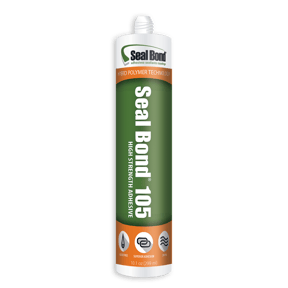
Key Benefits of SB 105:
- Fast-curing and permanently elastic
- Excellent primerless adhesion
- Solvent-, silicone-, and isocyanate-free
- Low odor and minimal shrinkage
- Paint compatible
- Available in white, gray, or black
SB 105 is Best For: Construction and industrial applications requiring durable, weather-resistant bonds.
Seal Bond® 150 HV High-Performance Adhesive
Seal Bond® 150 HV offers rapid strength development with high green strength for quick fixturing, while maintaining long-term flexibility after cure. 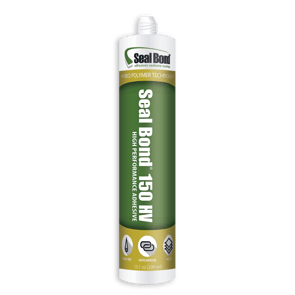
Key Benefits of SB 150:
- Very fast strength build with high initial tack
- Permanently elastic across a broad temperature range
- Solvent-, silicone-, and isocyanate-free
- Non-flammable and low odor
- Extremely low shrinkage
- Paint compatible
SB 150 is Best For: Industrial bonding applications where fast set times and high-performance strength are essential.
Frequently Asked Questions About Adhesive Strength
Q. What is a bond strength test?
A. Bond strength tests measure how much force an adhesive joint can withstand before failure, including shear, tensile, and peel testing, depending on the application.
Q. Can an adhesive have high shear strength but low tensile strength?
A. Yes. Some adhesives are optimized for lateral force resistance but are not designed for pull-apart stress, which is why load direction matters.
Q. What affects adhesive resistance over time?
A. Temperature changes, moisture, UV exposure, vibration, and material compatibility all influence long-term adhesive performance.
Q. Do hybrid polymer adhesives provide better overall strength?
A. Hybrid polymer adhesives are designed to deliver balanced shear and tensile performance while maintaining flexibility to accommodate movement.
Ready to Find the Right Adhesive for Your Application?
Choosing the right adhesive isn’t just about strength numbers—it’s about matching performance to real-world conditions.
Whether you need expert guidance, a product recommendation, or a sample to test in your application, Seal Bond is here to help.
Contact Seal Bond today to find an adhesive solution engineered for strength, durability, and long-term performance. Request a free sample to see the difference firsthand.